Partner Jim Kepner, Albert Ross Puryear
Queer Places:
University of Oklahoma, 660 Parrington Oval, Norman, OK 73019, United States
209 N Poplar St, Bristow, OK 74010
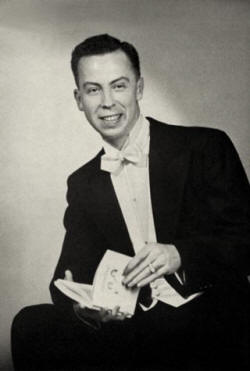 James Barr Fugaté (February 13, 1922 - March 28, 1995) published the novel Quatrefoil and other works under the pseudonym James Barr, an alias he also
used in his work as an activist in the homophile movement of the 1950s. He was briefly lovers with Jim Kepner. He became
involved with con artist Albert Ross Puryear.
James Barr Fugaté (February 13, 1922 - March 28, 1995) published the novel Quatrefoil and other works under the pseudonym James Barr, an alias he also
used in his work as an activist in the homophile movement of the 1950s. He was briefly lovers with Jim Kepner. He became
involved with con artist Albert Ross Puryear.
He was born on February 13, 1922, in Hallett, Oklahoma, an oilfield boomtown. His mother tragically
died of childbed fever during his birth, and he never knew his father. Although his illegitimate birth haunted him during his childhood, his adoptive
parents, who possessed wealth derived from wheat and oil in Kansas, provided him with a strong education.
Early in 1942, Fugaté enlisted in the United States Navy and sailed from San Francisco for Guadalcanal. Upon returning to the United States, he
completed Officers Training in Chicago. His military experiences later served as the basis for his best-known work, the novel Quatrefoil (1950), though a
central character in the book was patterned after a fraternity brother with whom Fugaté had engaged in a sexual relationship while studying at the
University of Oklahoma. Following the war, he returned to the university in 1946 to study professional writing, but after three semesters he relocated to
New York City. There, he supported himself by writing television advertising copy while finishing Quatrefoil, which was published by Greenberg, a
marginal publishing house attempting to reach a gay readership during an era of Cold War hysteria and McCarthyism.
Quatrefoil follows two naval officers, Phillip Froelich and Tim Danelaw, who meet in Seattle in 1946 and become lovers. While the novel reflected the
snobbery and disdain toward average homosexuals typical of the period, literary critics and early gay activists welcomed it as a rare, sympathetic, and
dignified portrayal of same-sex love that offered a corrective to the pathetic or flighty gay tropes of the 1940s. It was embraced by members of the
emerging homophile movement as a work that could inspire a sense of gay pride, despite the tragic conclusion involving the death of one of the lovers in
a car crash. In 1951, Fugaté published his second book, a short story collection titled Derricks, which focused on finding grounded men to love in the
Midwest.
In 1951, Fugaté moved to Los Angeles with aspirations of writing for the movies. However, in early 1952, he volunteered to return to active duty as a
reserve naval officer and was stationed in a base in Alaska. During a routine review of his Top Secret clearance, the Office of Naval Intelligence
discovered he was the author of Quatrefoil. This discovery triggered an eight-month interrogation that ultimately resulted in a General Discharge Under
Honorable Conditions.
This persecution deeply politicized Fugaté, transforming his view of homosexuality from a personal flaw he needed to fix into a social condition
deserving of societal understanding and acceptance. Consequently, he became heavily involved in the homophile movement of the 1950s. He contributed to
ONE Magazine in Los Angeles during its first year of publication in 1953, writing the short story "Death in a Royal Family," which was later adapted into
a play and performed in Zurich in 1956 by the Swiss gay group behind the magazine Der Kreis. Fugaté also wrote for Der Kreis, publishing a passionate
1955 article defending effeminate gay men against internal community snobbery, despite his own literary tendency to portray effeminacy negatively. That
same year, he began a brief stint writing a book column for ONE Magazine.
In May 1955, in anticipation of publishing his play Game of Fools, Fugaté publicly revealed his real name in an informative Mattachine Review article
detailing his discharge from the Navy. He was identified as James (Barr) Fugaté, with an editorial note explaining that his last name was pronounced
"Few-gay-tee"—an affectation that may have been adopted to distance himself from his Middle American roots. His play Game of Fools, which explored the
arrest and aftermath of four gay college students in a cabin and exposed pervasive religious bigotry, was published in June 1955, and its second act was
performed in German in Zurich later that year to celebrate the 25th anniversary of Der Kreis.
By April 1956, Fugaté reflected on the psychological state of homosexuals in the Mattachine Review, expressing the era's common homophile belief that
homosexuality was not an ideal state and that thousands might lead normal lives if early, affordable psychiatric treatment were available—a viewpoint
reflective of the psychiatric pressures of his generation.
In the early 1960s, Fugaté returned to New York, where an agent helped him reissue Quatrefoil in 1965 and publish his second novel, The Occasional
Man, in 1966. The Occasional Man was more autobiographical, featured explicit gay sex scenes, and followed a forty-year-old man recovering from the end
of a long-term relationship through interactions with four distinct men.
Following this period, Fugaté returned to Kansas to live with his mother, working as a newspaper reporter and photographer. After her death in the
early 1970s, he collected his inheritance and moved back to New York. Later, an unspecified event required him to complete a period of hospital work,
leading him to relocate to Oklahoma. He ended up working in a hospital for ten years instead of the originally required five, eventually retiring with a
small pension.
James Fugaté died on March 28, 1995, in Claremore, Oklahoma. Although his active participation in the gay movement was brief, his literary
contributions remain an important and illuminating window into the secrecy, struggle, and emerging consciousness of the early homophile movement for
LGBTQ+ equality.
References:
Other references:
- Barr, James (James Fugaté) (1922-1995)
by Hubert Kennedy
Encyclopedia Copyright © 2015, glbtq, Inc.
Entry Copyright © 2005, glbtq, inc.
Reprinted from https://www.glbtq.com
Support this project
This website is a passion project researched, developed, and funded entirely by me. If you find the content valuable and would like to help support the ongoing research and hosting costs, any contribution is deeply appreciated.
Thank you for keeping this independent resource alive!
My books on Amazon: Elisa Rolle's books
BACK TO HOME PAGE